
Categories
Latest blog
Why Your Shampoo Bottle May Be Costing You More Than You Think?
2026-10-16When choosing shampoo packaging, many brands focus primarily on the unit price. However, the cheapest bottle is not always the most cost-effective option.
From material selection to transportation and production efficiency, several factors can influence the total cost of shampoo packaging. Understanding these details can help brands make smarter purchasing decisions without compromising quality.
Bottle weight is one of the first factors worth reviewing. A heavier bottle may offer a more substantial feel, but it also requires more material.
For large-volume orders, even a small difference in the weight of each bottle can add up significantly. The goal is to find the right balance between material usage, durability, and the desired appearance.
For premium products, a thicker-wall PET bottle may be suitable, while HDPE bottles can be a practical choice for many everyday shampoo products.
Packaging costs go beyond the factory price. Bottle dimensions, carton size, and loading efficiency can all affect shipping expenses.
Bulky bottles may take up more space during transportation, increasing the cost per unit. When comparing packaging options, brands should consider not only the unit price but also how efficiently the bottles can be packed and shipped.
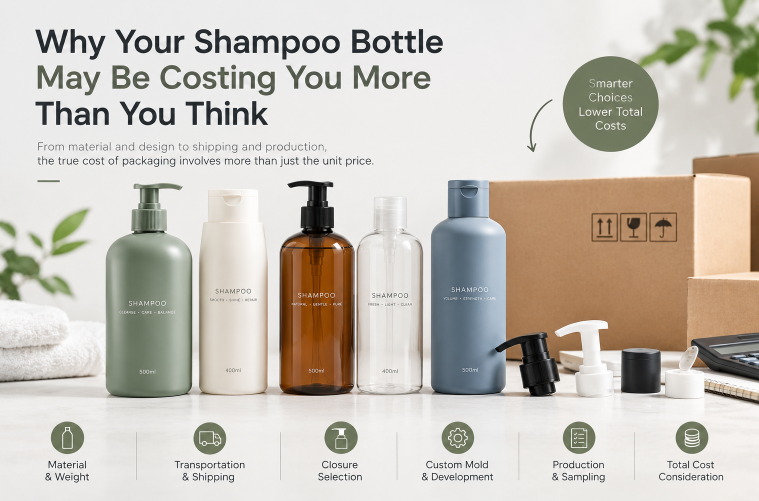
The closure is another important part of the total packaging cost.
Lotion pumps can offer convenience and a premium appearance, while flip-top and disc-top caps may be more suitable for everyday shampoo products.
Choosing a closure that matches the product's positioning and dispensing requirements can help avoid unnecessary costs. Compatibility between the bottle neck and closure should also be checked before mass production.
Custom bottle designs can help a brand stand out, but mold development requires additional investment.
Before creating a new mold, consider whether an existing bottle shape could meet your requirements through custom colors, printing, or surface finishes.
If a distinctive shape is essential to your brand identity, custom mold development may be worthwhile. The decision should be based on your order volume, budget, and long-term product plans.
Changes made after mass production begins can lead to delays, additional expenses, or wasted packaging materials.
Before approving an order, brands should review samples, bottle dimensions, color, decoration, closure compatibility, and filling requirements.
Testing packaging with the actual formula and dispensing components can also help identify potential issues before a large order is produced.
A lower-priced bottle may not deliver the best overall value if it creates problems with filling, transportation, or product presentation.
When evaluating shampoo packaging, consider:
Unit price and material weight
Bottle and closure compatibility
Carton dimensions and shipping efficiency
Decoration and mold costs
Quality consistency and production requirements
A well-planned packaging solution can help control costs while maintaining the quality your customers expect.
Your shampoo bottle may be costing more than you think, but reducing packaging costs does not necessarily mean choosing the cheapest option.
By reviewing bottle weight, transportation efficiency, closure selection, and production requirements, brands can identify opportunities to improve cost efficiency without sacrificing functionality or appearance.
Finepack offers customizable PET, PETG, HDPE, PP, and PCR plastic packaging for shampoo, conditioner, body wash, and other personal care products. From standard bottle options to custom shapes, colors, and finishes, we help brands explore packaging solutions that balance design, performance, and cost.